
Author
Team Healthgroovy
How Employee Productivity Monitoring Can Help Reduce Workplace Stress and Prevent Burnout
- The Connection Between Productivity, Workplace Stress, and Burnout
- Can Employee Monitoring Actually Reduce Stress?
- Productivity Signals That May Reveal Workload Problems
- Turning Productivity Data Into Burnout Prevention
- The Burnout Early-Warning Loop
- Monitor Workload, Not Employees' Every Move
- What Not to Measure—or Misinterpret
- U.S. Privacy and Employee-Monitoring Considerations
- A Practical Checklist for Burnout-Conscious Productivity Monitoring
- Frequently Asked Questions
- Use Monitoring to Improve Work, Not Intensify It
Employee productivity monitoring can help employers spot sustained overtime, workload imbalances, meeting overload, and changing work patterns early. But the data should improve working conditions. It should not judge employees. Intrusive surveillance can raise stress. So effective monitoring needs useful workload signals plus transparency, context, and supportive management.
The principle is simple: use monitoring to fix the work, not to police the worker.
The Connection Between Productivity, Workplace Stress, and Burnout
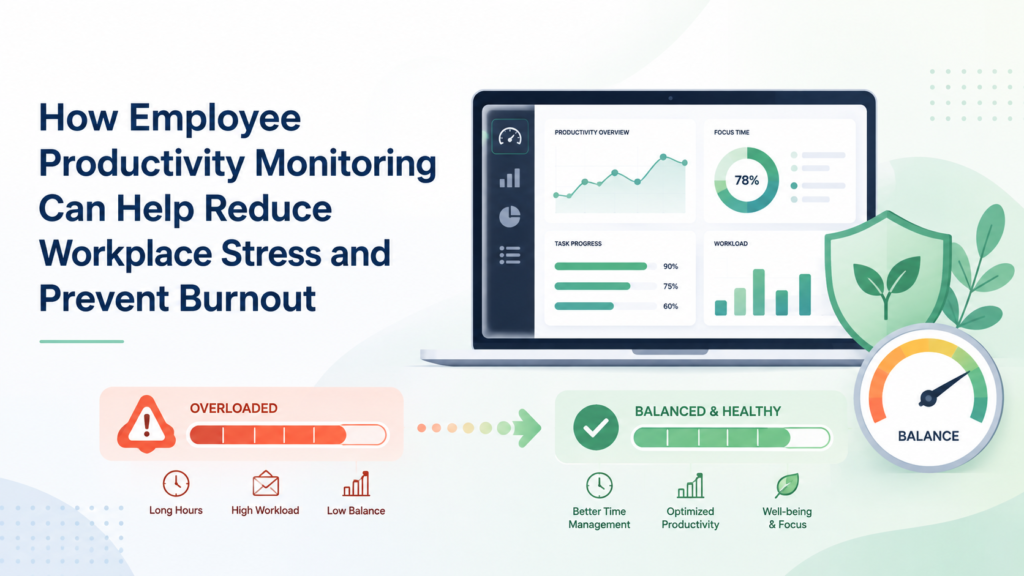
Burnout is not just a time-management problem. Work design and management conditions matter too.
Gallup found five workplace experiences that link strongly to burnout: unfair treatment, unmanageable workload, unclear manager communication, lack of manager support, and unreasonable time pressure. The World Health Organization (WHO) agrees. WHO lists heavy workloads and low job control among the workplace risks to mental health. WHO also estimates that depression and anxiety cause about 12 billion lost working days worldwide each year.
These conditions often leave visible patterns in how work gets done. A team may start working later into the evening. One person may carry much more work than their peers. Meeting time may rise while focus time disappears. Deadlines may repeatedly force overtime.
Employee monitoring can make these patterns easier to see. But it can’t explain them on its own.
A rise in working hours, for example, could come from many things: an unrealistic workload, temporary project demands, poor staffing, inefficient processes, unclear priorities, or a different work schedule. That’s why employee monitoring data should start a conversation, not decide a conclusion.
Can Employee Monitoring Actually Reduce Stress?
Yes, but only under the right conditions.
The American Psychological Association found that 56% of workers who reported being monitored also said they typically feel tense or stressed during the workday. Only about 40% of unmonitored workers said the same. Monitored workers were also more likely to report feelings tied to burnout.
A 2022 meta-analysis covering 70 independent samples and 233 effect sizes found that electronic monitoring came with slightly higher stress and slightly lower job satisfaction. It found almost no overall link between monitoring and performance.
So the useful question isn’t:
“How can we monitor employees more closely?”
It’s:
“How can we use appropriate work data to spot unhealthy conditions without creating more pressure?”
When monitoring can help
Productivity and workload monitoring can support burnout prevention. Employee monitoring software such as Apploye can be used as part of this process when the goal is to understand work patterns and workload rather than scrutinize employees without context. For distributed teams, remote workforce management software can also give managers better visibility into working hours and workload patterns without relying solely on physical presence. It helps managers:
- identify persistent overtime and after-hours work;
- detect workload imbalances across a team;
- see whether meetings are crowding out focus time;
- uncover inefficient or repetitive workflows;
- identify unrealistic deadlines or capacity problems;
- spot sustained changes in working patterns; and
- redistribute work before overload becomes chronic.
When monitoring can make stress worse
Monitoring is more likely to hurt well-being when organizations rely on:
- constant screenshots or keystroke counts;
- aggressive idle-time tracking;
- treating visible activity as productivity;
- monitoring outside expected working hours;
- disciplinary decisions based on a single metric;
- unclear monitoring policies; or
- collecting data employees don’t know is being collected.
The difference comes down to purpose. Workload analytics should help managers understand the work system. It should not turn every employee action into a performance score.
Productivity Signals That May Reveal Workload Problems
The strongest employee burnout monitoring strategy looks for sustained patterns and pairs them with human context.
| Productivity signal | What it might indicate | Supportive manager response |
| Sustained after-hours work | Excessive workload or unrealistic deadlines | Review capacity and redistribute work |
| Rising overtime | Understaffing, scope creep, or deadline pressure | Rebalance projects and priorities |
| Heavy meeting load | Too little uninterrupted focus time | Remove or shorten unnecessary meetings |
| Frequent context switching | Fragmented workflows or interruptions | Protect focus blocks |
| More hours but lower output | Fatigue, complexity, or process problems | Investigate causes with the employee |
| Uneven team workload | Poor distribution of responsibilities | Reassign work where appropriate |
| Repeatedly missed breaks | Pressure or unrealistic scheduling | Review workload and protect breaks |
| Sustained schedule changes | Workload issues or other circumstances | Hold a supportive conversation |
| Sudden productivity change | Many possible work or personal factors | Ask, do not assume |
Productivity data cannot diagnose burnout or a mental-health condition.
Behavioral data is just a signal to investigate. A productivity decline may come from complex work, technical problems, meetings, training responsibilities, blocked dependencies, or activity the software simply doesn’t capture.
The manager’s job is to investigate the observable work problem. It is not to guess at an employee’s medical or psychological condition.
Turning Productivity Data Into Burnout Prevention
A practical workflow is:
Detect → Discuss → Diagnose the work problem → Intervene → Measure again
1. Detect sustained patterns
Look for trends, not isolated incidents.
One late evening may mean little. Repeated after-hours work for several weeks deserves attention. A temporary drop in output during a difficult project may be normal. But a sustained decline, combined with rising hours and a growing backlog, may signal a capacity or process problem.
Avoid creating automatic “burnout scores.” The goal is to find patterns worth discussing.
2. Discuss the pattern
Suppose an employee has worked nine or ten hours a day for three weeks, and their output is starting to fall.
A poor response is:
“Why is your productivity score declining?”
A better response is:
“We’ve noticed your workload and hours have increased over the past few weeks. Is something about the workload, deadlines, priorities, or process making the job harder than it should be?”
The second approach treats the data as context, not an accusation.
3. Diagnose the work problem
Ask what’s happening upstream:
- Are too many projects assigned to one person?
- Have deadlines become unrealistic?
- Are priorities changing too often?
- Are meetings consuming focus time?
- Is the employee blocked by another team?
- Are repetitive tasks taking unnecessary time?
- Is staffing sufficient?
- Are expectations clear?
This matters because burnout risk connects strongly to workload, manager support, communication, and time pressure.
4. Intervene
Once the problem is clearer, managers can act. They can redistribute tasks, extend unrealistic deadlines, reduce project scope, add resources, eliminate unnecessary meetings, automate repetitive work, create protected focus periods, clarify priorities, limit unnecessary after-hours communication, and encourage appropriate time off.
The U.S. Surgeon General’s workplace well-being framework backs this up. It emphasizes worker voice, autonomy, flexibility, adequate rest, and clear boundaries between work and non-work time. These are useful principles for deciding what to change once a workload problem is identified.
5. Measure again
Check whether the intervention worked.
Did overtime decrease? Did workload become more balanced? Did meeting time fall? Did employees regain focus time?
Then ask the employee a simple question: does it actually feel more manageable now?
Quantitative data shows what changed. Employee feedback shows whether the change actually solved the problem.
The Burnout Early-Warning Loop
A responsible productivity-monitoring process looks like this:
Productivity data
↓
Detect sustained patterns
Overtime • workload imbalance • meeting overload • changing productivity
↓
Human check-in
“What is causing this pattern?”
↓
Workplace intervention
Redistribute work • adjust deadlines • reduce meetings • remove blockers • increase autonomy
↓
Measure improvement
Hours normalize • workload improves • employee feedback improves
This loop should always run inside four safeguards:
Transparency • Privacy • Employee awareness • Context
Monitor Workload, Not Employees’ Every Move
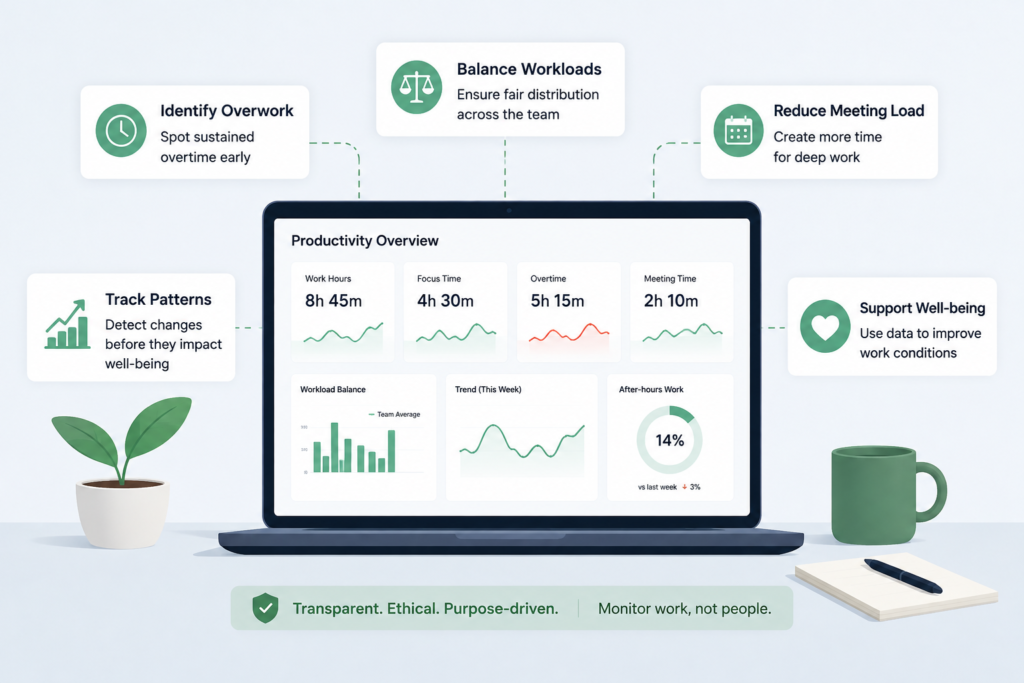
A useful rule is:
Measure enough to identify workplace problems, but no more than necessary.
Be transparent
Employees should know what information you collect, why you collect it, who can access it, and how you use it.
Limit monitoring to a defined purpose
“Improve productivity” is too vague to justify collecting every available metric.
A clearer purpose might be:
“We review workload and working-hour patterns to identify capacity problems and improve resource allocation.”
Whether an organization uses Apploye or another employee monitoring software, the tool should support a clearly defined management purpose rather than become a reason to collect every available activity metric.
Use role-relevant measures
Developers, support agents, designers, salespeople, and managers all do different work. A single activity score won’t represent all of them fairly.
Prefer team-level data when possible
If the question is whether a department has excessive meeting load or chronic overtime, aggregated trends may work better than scrutinizing individuals.
Give employees a voice
Employees should be able to explain unusual or inaccurate data. Consequential decisions should never rest on one metric alone, without context.
What Not to Measure—or Misinterpret
Some metrics look objective because they produce precise numbers. That doesn’t make them meaningful measures of performance or employee well-being.
Do not automatically equate:
- mouse movement with productivity;
- idle time with laziness;
- website categories with disengagement;
- hours online with effectiveness;
- frequent breaks with burnout; or
- lower productivity with mental illness.
Knowledge work often includes thinking, reading, planning, reviewing, conversations, and offline tasks. Monitoring software may not capture any of this well.
Longer hours aren’t automatically better, either. They can reflect poor processes, unrealistic workloads, or understaffing.
The safest interpretation is:
A metric tells you what the system recorded, not why it happened.
U.S. Privacy and Employee-Monitoring Considerations
This is general information, not legal advice.
Employee-monitoring requirements in the United States vary by jurisdiction and type of monitoring. Employers should review the laws that apply where their employees work.
For example, New York requires covered employers engaging in specified electronic monitoring of telephone, email, or internet activity to provide prior written notice upon hiring and post a monitoring notice.
Connecticut generally requires employers conducting covered electronic monitoring to give affected employees prior written notice, subject to statutory exceptions.
Delaware requires covered employers to provide notice before monitoring or intercepting specified telephone, email, or internet activity, and it defines the methods for giving that notice.
Before implementing monitoring, define what data you’ll collect, why it’s necessary, who can access it, when monitoring occurs, how you’ll notify employees, and how long you’ll retain the data.
A Practical Checklist for Burnout-Conscious Productivity Monitoring
Before monitoring: Define the work problem. Collect only necessary data. Review applicable privacy requirements. Clearly explain the monitoring to employees.
While monitoring: Look for sustained trends rather than daily fluctuations. Prioritize workload and work-design signals over invasive activity metrics. Consider role and project context. Let employees explain unusual patterns.
When a concerning pattern appears: Ask before assuming. Investigate workloads, deadlines, staffing, processes, and priorities. Change working conditions where appropriate, rather than trying to diagnose the employee.
After an intervention: Review the data again. Ask employees whether the change helped. Adjust your response if the underlying problem remains.
Frequently Asked Questions
Ans: Yes. Monitoring can contribute to stress when employees find it intrusive, punitive, excessive, or poorly explained. APA survey data found higher reported workplace stress among monitored workers than among workers who did not report being monitored.
Ans: It can help identify workload patterns, such as sustained overtime, uneven assignments, or excessive meetings. Those signals should trigger investigation and support, not an automatic burnout conclusion.
Ans: Software should not diagnose burnout. But from a management perspective, watch for persistent overload, unreasonable time pressure, unclear expectations, and insufficient support. These workplace conditions are linked to burnout.
Ans: Useful signals include sustained overtime, repeated after-hours work, workload distribution, meeting load, project capacity, and long-term changes in working patterns.
Ans: Overtime can point to workload pressure, but it doesn’t prove burnout on its own. Managers should check whether the overtime is sustained and ask what’s causing it.
Ans: Break patterns may add workload context, but breaks shouldn’t become a productivity score. Repeatedly missed breaks may instead be a reason to review scheduling or workload.
Ans: Focus on capacity, deadlines, overtime, assignment distribution, meeting load, and workflow bottlenecks, rather than minute-by-minute activity.
Ans: It can be lawful, but the rules vary by jurisdiction and monitoring method. Some states impose specific notice requirements, so employers should get advice suited to their workforce and practices.
Ans: No. Productivity and activity data can identify work patterns, but it can’t clinically diagnose burnout, depression, anxiety, or any other mental-health condition.
Use Monitoring to Improve Work, Not Intensify It
Employee productivity monitoring can help organizations spot excessive hours, workload imbalances, meeting overload, fragmented workflows, and capacity constraints before they become bigger problems.
But detecting a pattern is only the first step.
The responsible approach is to see the pattern, ask what’s causing it, improve the work environment, and measure whether conditions get better.
When monitoring is transparent, limited, contextual, and focused on workload, it gives managers useful information for burnout prevention. When it becomes constant surveillance, or activity scores replace management judgment, it can add pressure instead. Both APA survey findings and research on electronic monitoring support this.
The goal isn’t to watch employees more closely.
It’s to understand work well enough to make it healthier and more sustainable.
