
After moving to Geneva, an eye appointment can come up long before the paperwork is finished. Swiss health insurance rules, several of them written for new residents, decide when such a visit is reimbursed, whether a specialist can be booked directly and what share of the bill stays with you.
Finding an eye specialist who works in English
French is the official language of the canton of Geneva, as article 5 of its constitution states. Describing a symptom precisely and following a treatment plan is easier in a language you master, so it is worth asking about languages when you book. Dr Bela, an English-speaking ophthalmologist in Geneva, for instance, lists French and English on her profile and was a fellow in oculoplastic surgery at Moorfields Eye Hospital in London in 2018. A specialist in ophthalmology and member of the FMH, the Swiss Medical Association, she practices general ophthalmology, cataract surgery and oculoplasty, the branch of eye surgery that treats the eyelids, tear ducts and orbit.
Health insurance comes before the appointment
Under the Federal Health Insurance Act (LAMal), anyone who takes up residence in Switzerland must take out basic health insurance within three months, and for most foreign nationals holding a permit, those three months run from registration with the residents’ office. Join within that window and cover starts on the registration date, so an eye visit in your first weeks falls inside it. Join later and cover starts only on the day you join, with a premium surcharge of 30 to 50% for twice the length of the delay, up to five years, unless the delay was excusable.
Geneva enforces the rule through its Service de l’assurance-maladie (SAM), the cantonal health insurance office, which writes to new residents after their arrival. The canton states that affiliation must be effective within three months even if the residence permit has not yet been issued. Without proof of insurance by then, the SAM assigns an insurer itself. Basic insurers are private companies, but the benefits they cover are set by law and are the same at every insurer.
Who can ask to be exempted
The canton accepts requests to stay outside the LAMal from:
- members of a diplomatic mission and international civil servants, current or former;
- people insured in a country that has no agreement with Switzerland;
- students, pupils and trainees, and people in further training;
- posted workers exempted from Swiss old-age and disability insurance contributions, with their families;
- holders of a residence permit for people without gainful employment;
- people whose current cover goes beyond the LAMal and who would lose protection by switching.
The existing cover has to be at least equivalent to what Swiss law requires for treatment in Switzerland, and the request must reach the SAM within three months of arrival.
Booking an ophthalmologist with or without a referral
The LAMal guarantees a free choice of doctor for outpatient care, but you can give part of it up by picking a model with a limited choice of providers, for which insurers may lower the premium. From 2027, the federal premium calculator, Priminfo, groups these models into four categories, each with a first point of contact you commit to using.
| Model | First point of contact | Route to an ophthalmologist |
| Standard | Any doctor admitted to practice | Book directly |
| PRAXIS | A designated practice, such as a family doctor or a medical center | A referral from that practice when needed |
| TEL_DIG | A telemedicine service, by phone or online | After contacting the service first |
| PHARM | A pharmacy that partners with your insurer | After going to the pharmacy first |
| FLEX | Your choice among several of these contact points | After using one of those contact points |
Each model can carry its own rules on which providers to use, and the Federal Office of Public Health advises reading the insurance conditions before choosing. Those conditions decide whether an eye problem can go straight to a specialist.
What a visit costs you
Since January 1, 2026, a consultation has been billed under TARDOC, the new national outpatient tariff, in which each service carries tariff points multiplied by a point value in francs set canton by canton. A more complex service carries more points, so a visit with extra examinations costs more than a short check. Depending on the agreements in place, the bill goes either to you, and you claim the amount from your insurer, or directly to the insurer, the arrangement most used today according to the FMH.
Under the LAMal’s cost-sharing rules, adults pay a deductible of at least 300 Swiss francs per calendar year, or an optional higher one of up to 2,500 francs in exchange for a lower premium. Until your bills for the year reach that deductible, you pay them in full. Above it, you pay 10% of the costs, up to 700 francs a year. Children pay no deductible unless their parents opt for one, and their 10% share is capped at 350 francs. In March 2026, the Federal Council opened a consultation on raising the minimum deductible to 400 francs, a change that requires an amendment to the law.
What happens at the first consultation
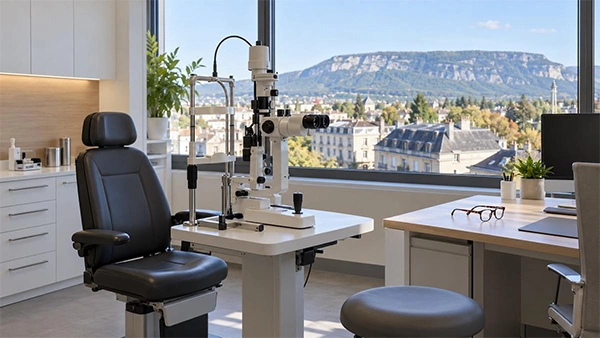
At the practice of Dr Cyrielle Bela, at Chemin de Beau-Soleil 12 next to the Clinique Générale Beaulieu, a first visit starts with the administrative formalities at the front desk. An orthoptist, an eye-care professional who works alongside the doctor, then tests your vision, takes the measurements needed for glasses and checks your eye pressure, adding further examinations when the results call for them. The ophthalmologist then examines you, makes the diagnosis, writes your glasses prescription and explains any treatment or surgery to plan. The practice receives patients Monday to Thursday, from 8 a.m. to 5 p.m.
